

Description
Golden Halo is a distinctive variety recognized for its warm golden coloration, unique spore characteristics, and intriguing history. Unlike many modern designer cultivars with well-documented breeding records, the exact origins of Golden Halo remain uncertain. Over the years, several accounts have emerged within the mycology community, with some suggesting the variety originated from a wild Jamaican collection, while others believe it descended from a wild Gulf Coast isolate that was later stabilized. Because no official breeding records exist, its precise origin has never been conclusively established.
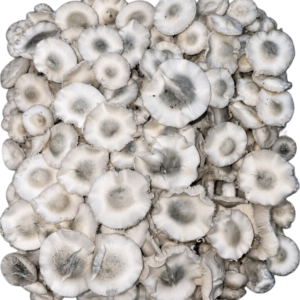
Golden Halo is best known for a characteristic that sets it apart from most varieties. Its unusual golden to rust-colored spore prints. While the species is traditionally known for producing dark purple-brown spores, certain stabilized Golden Halo isolates consistently produce noticeably lighter spore deposits. This rare trait inspired the variety’s name and continues to make it an interesting subject for collectors and microscopy enthusiasts studying natural genetic variation within cubensis. Not every isolate expresses the same level of golden pigmentation, but it remains one of the defining features associated with the lineage.
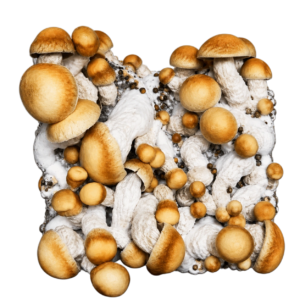
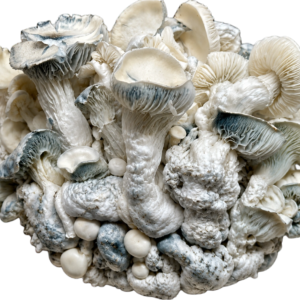
Morphologically, Golden Halo displays the classic characteristics. Mature specimens commonly develop golden stems, medium to large fruiting bodies, and golden to caramel-colored caps that broaden as they mature. Many mushrooms develop a subtle golden ring or halo across the cap surface, while vivid cobalt-blue bruising appears where the tissue is handled, creating an attractive contrast against the warm coloration.
Within the mycology community, Golden Halo is appreciated not only for its appearance but also for its apparent connection to relatively recent wild genetics. Compared to many heavily refined designer cultivars, Golden Halo is often regarded as a variety that has retained much of the natural diversity found in wild populations while still expressing a stable and recognizable phenotype. This balance of natural heritage and consistent morphology has made it a valued addition to many genetics collections.


Reviews
There are no reviews yet.